
Después de que fue cancelado en 2020, Gallery Weekend en México regresa este año con 50 nuevas y viejas galerías.
Camila Osorio
This weekend, from Friday to Sunday, more than 50 art galleries in Mexico City will open new exhibitions to the public for the fair known as Gallery Weekend, an annual initiative that began in 2013 and follows the format of other iconic art fairs of the same name in Paris, Berlin, and London. This weekend’s exhibitions present an enormous mosaic of themes, but above all offer compelling reflections on how the body, memory, and the possibilities of technology are represented.
Gallery Weekend was canceled last year due to the risk of coronavirus contagion, and in 2020 several galleries had to attempt to exhibit and sell their artists’ works solely through their websites, social media, or by occasionally inviting select collectors. Now, with the green light status in the capital, the doors are fully open not only for larger galleries such as Kurimanzutto—which is presenting its exhibition Siembra—but also for new, smaller galleries that are beginning to carve out a space in the art market.
“This is our first solo exhibition,” says Fátima González, cofounder of Galería Campeche, one of the city’s newer spaces participating in Gallery Weekend. Revertir el Desgaste (Reversing Wear), the title of the exhibition, is a group of sculptures by Mexican artist Julieta Gil, who has become known for her reflections on statues in the capital and their relationship to feminism. After women activists spray-painted graffiti such as “México feminicida” on the Angel of Independence in 2019, the artist began creating several works that question the city’s process of repairing the monument. In the current exhibition, one of the works consists of four marble plaques that imitate those at the base of the Angel of Independence, titled La Ley, La Paz, La Guerra, and La Justicia. “Cracks are present here,” reads one plaque. “Beneath this sculpture lie faults,” reads another. Law and justice at the monument’s base, in a country where so many women are murdered with impunity, undoubtedly contain cracks and failures.
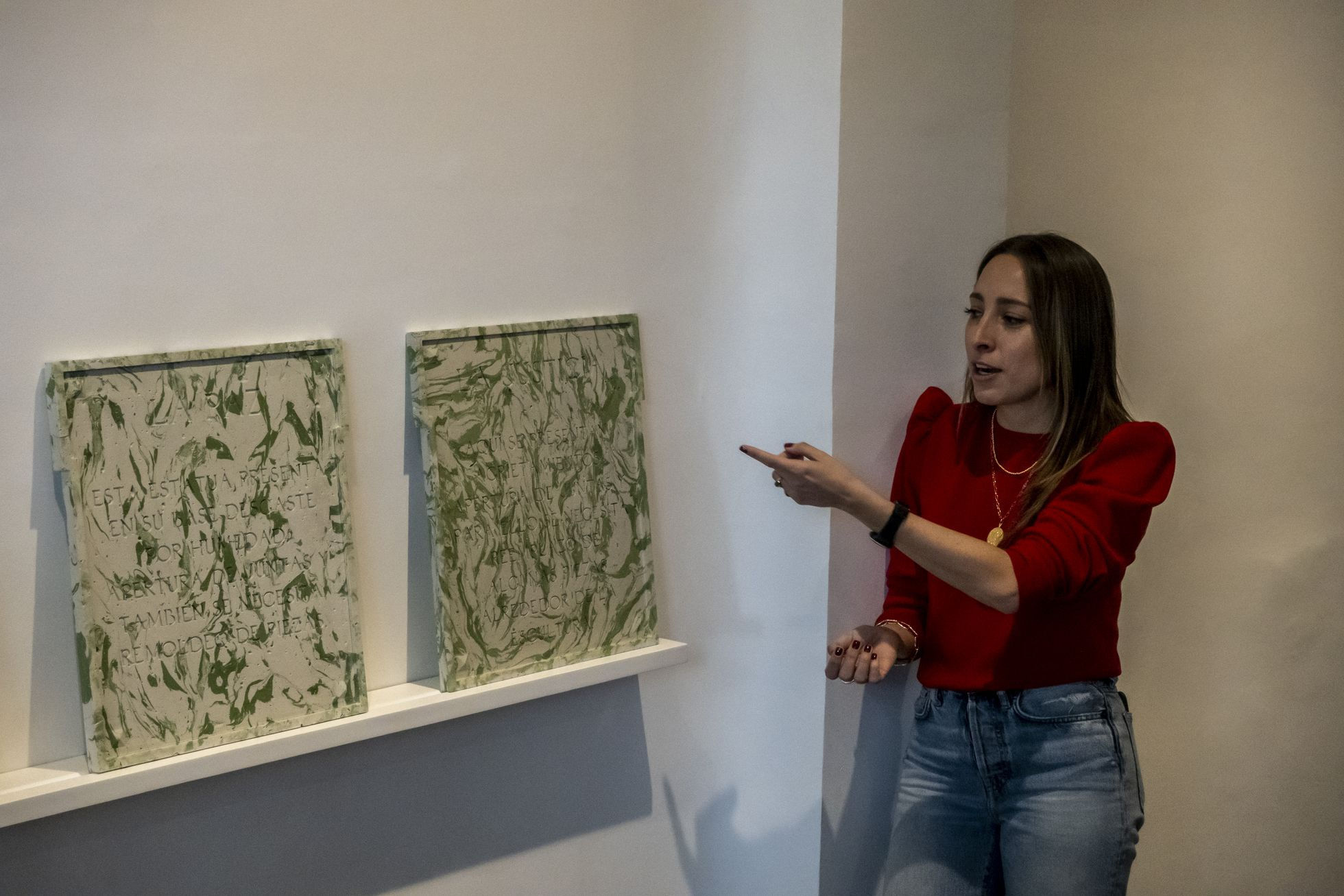
Fátima González, cofounder of Galería Campeche, explains to the visitors of the exhibition of Julieta Gil.
HECTOR GUERRERO
“Do these statues really need restoration? Or is it not the sculpture but the system itself that needs to be restored?” says González as she presents Gil’s work. Another of the pieces, Hombres Ilustres (Illustrious Men), is a 3D video in which the artist recreates 77 statues of male figures along Paseo de la Reforma, but in a much smaller version, almost beheading the men in the process. “Who is truly an illustrious man, and who decides?” González asks.
A few blocks west from there, another reflection on the past takes place—this time focused more on colonization than on machismo. Three artists from Guerrero, Oaxaca, and Morelos are exhibiting their works at Galería L, a space that had tried to survive in the digital realm since the start of the pandemic and that this weekend celebrates its first physical exhibition since March 2020. “Here you see concerns about the consequences of colonialism in Mexico,” says Carlos Camp, part of the gallery’s curatorial team, introducing the exhibition titled Ensayos desde El Trópico (Essays from the Tropics).
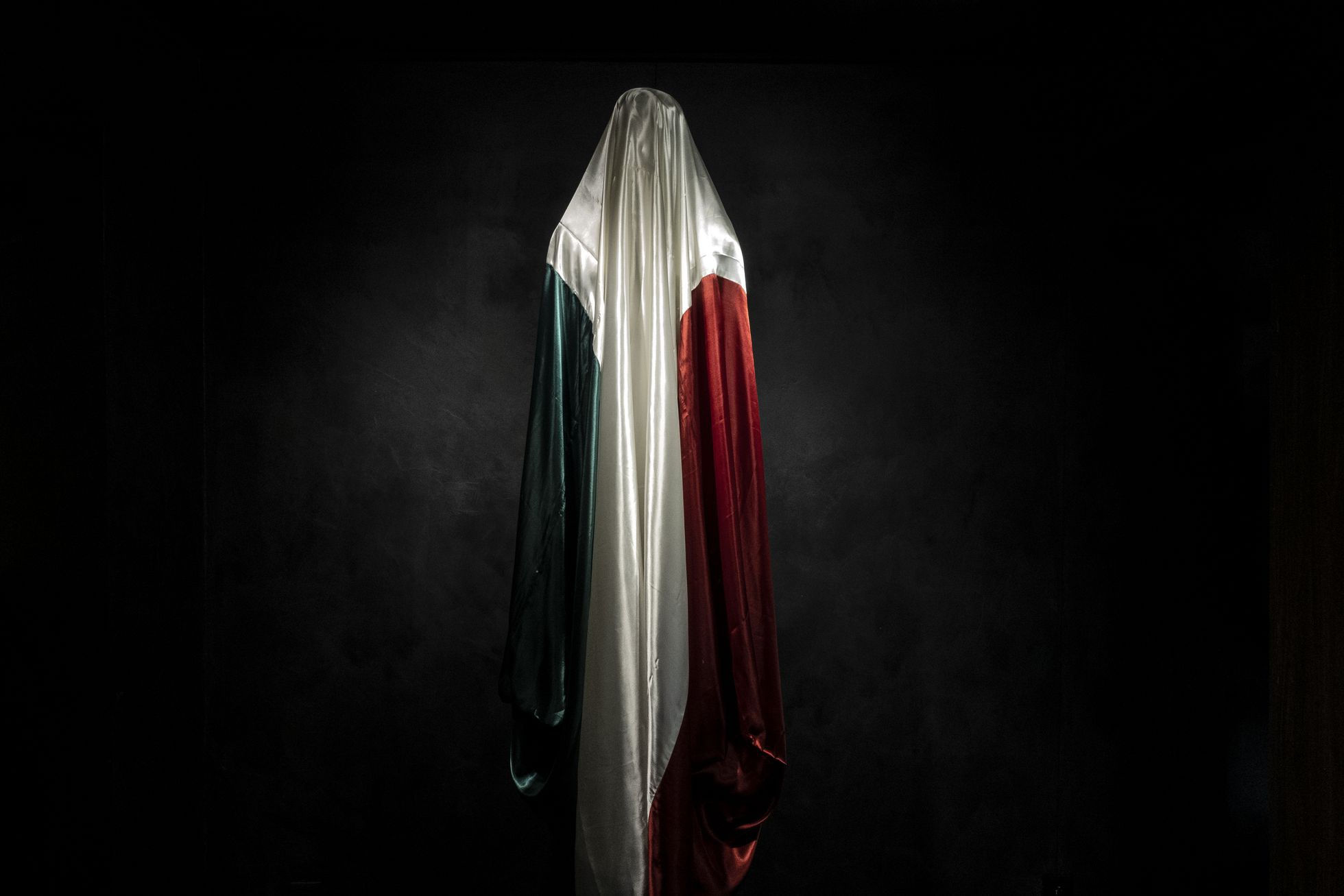
The piece `Augurio` of Josué Morales at galería L.
HECTOR GUERRERO
The three artists exhibiting there—Imanol Castro, Jaime Ruíz Martínez, and Josué Morales—present parodies of Spanish codices that depicted Indigenous peoples as savages; ghosts wrapped in the Mexican flag questioning the country’s mestizo identity; and palm trees that seem to dissolve into the memory of a canvas. “Several of them come from southern Mexico, from places considered marginal, and they play with representations of the tropics in different ways, reclaiming objects that were or still are considered peripheral,” says Camp.
Leaving behind concerns of the past and looking toward the future, not far from there is the gallery Travesía Cuatro, where two Portuguese artists—Alexandre Estrela and João Maria Gusmão—have created an impressive animated spectacle by fusing abstract drawings with complex video systems. The result is a series of works that, like a Frankenstein, come to life. “Through a play of shadows and light, we managed to transform these figures into living entities,” Estrela explains about some of the pieces in the exhibition titled Día Eléctrico (Electric Day).
The gallery has closed its windows so the videos can be seen clearly, and entering now feels like stepping into a darkroom. Videos appear on the gallery walls with figures whose colors shift mysteriously, and part of the artistic game lies in the sense of disorientation they provoke in the viewer. “[The lights] are arranged in such a way that they can produce an infinite number of combinations,” Estrela explains about how the colors of circles and other geometric shapes change. “All the drawings have the potential to become animation and autonomous beings.” It’s like watching a Kandinsky painting suddenly begin to move on its own.
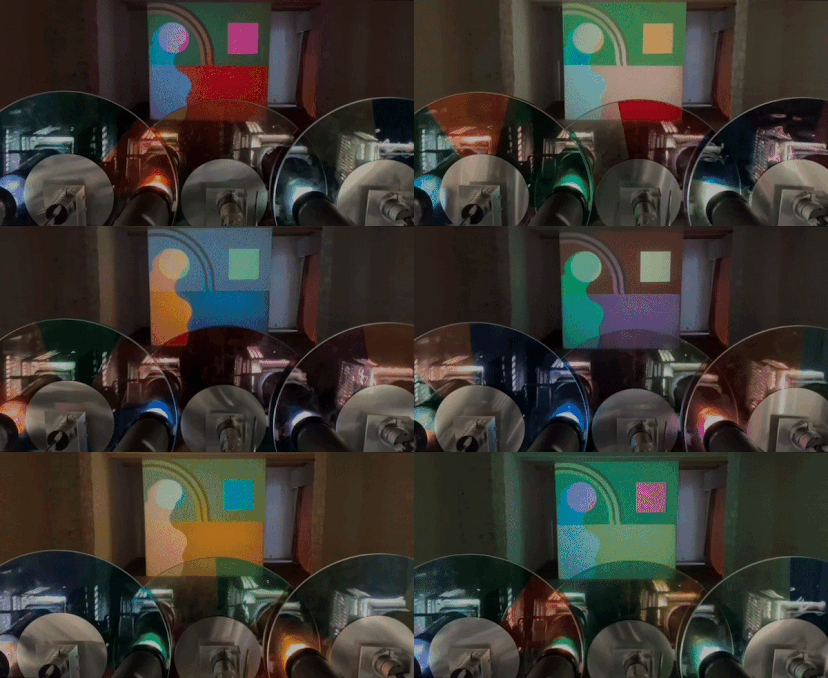
La pieza linterna mágica of João María Gusmão, at galería Travesía Cuatro
Further north of the Roma and Condesa neighborhoods—where most of the galleries are located—Polanco becomes home to other frontiers of technology, though more concerned with the depths of the web. There, Italian-Mexican artist Pedro Friedeberg has immersed himself in the world of crypto art: at Galería Cam, several of his new encrypted codes known as NFTs are on view. Further south, in Iztaccíhuatl, is Biquini Wax, a house that functions as a collective space for various artists. This weekend, the space will present an exhibition by artist Erik Balderrama titled Portal Cautivo, in which, among other pieces, he transformed digital data into small charms adorning dog collars—digital data that corners and suffocates. “What he did was create a sculpture using the data that appears when a person connects to the Wi-Fi in the house,” explains Israel Urmeer, an artist and member of the collective. A dystopian exhibition about the limits to which digital capitalism has taken us, and the extent to which, like dogs, we are already in captivity—caged within metadata.
©2021 El País
