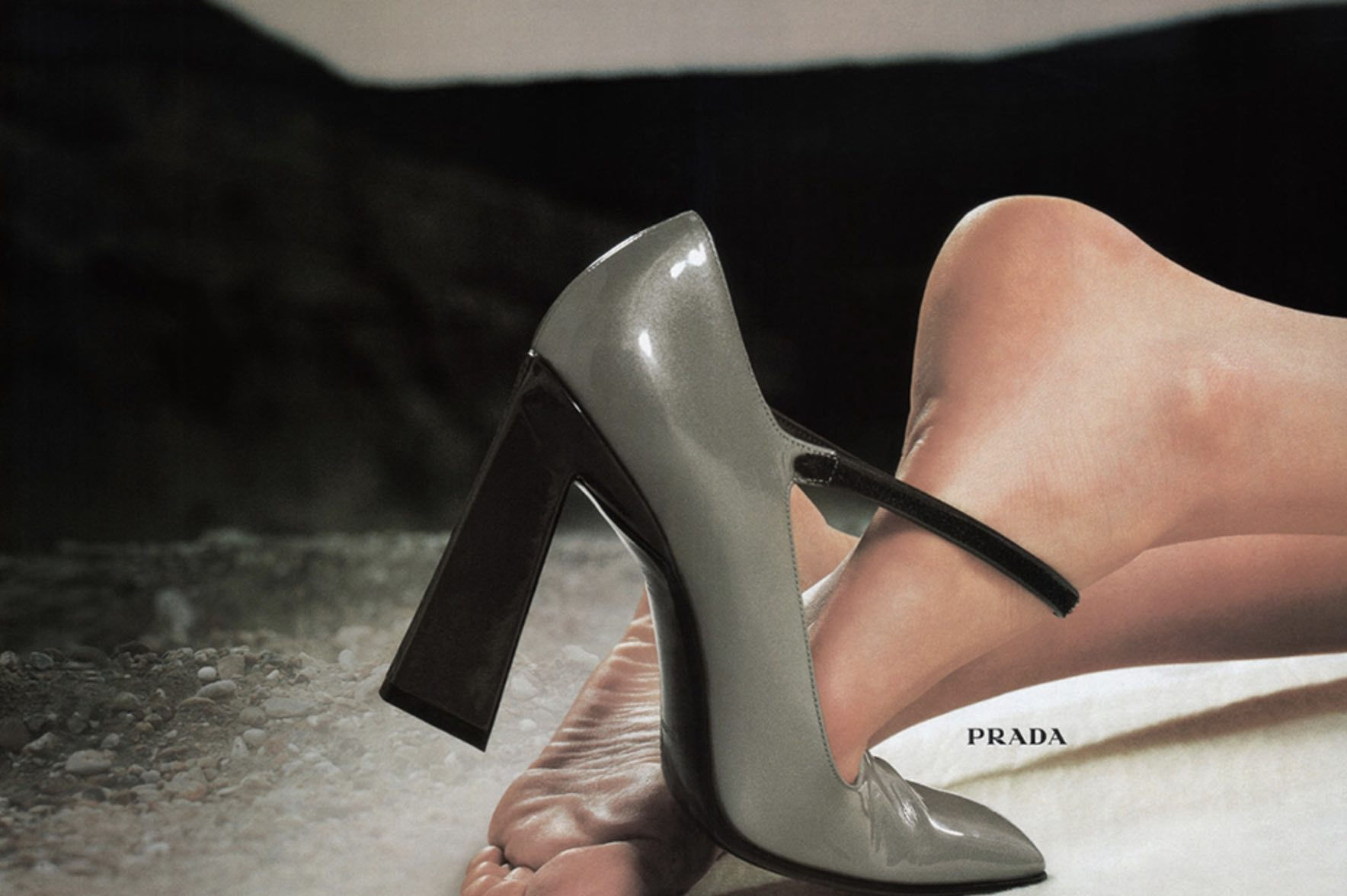
When I was a teenager, my love of images was deeply nurtured through fashion magazines. It was within those pages that I intuitively began to develop a sense of proportion, an appreciation for color, and above all, a particular sensitivity to light. The glossy pages of magazines have that finish due to a mixture of polymers that add certain qualities to the paper on which they are printed, creating that silky smooth surface. Because the ink is less absorbent, the polymers quite literally push the photographs to the surface, making it possible for our eyeballs to glide coolly over them. I would tear out pages and place them on the walls of my room, looking at them while doing homework or getting ready for school. Through this exercise I learned about the flow of space, about montage and juxtaposition, about the speed at which desire moves through the act of seeing. A fern-green Mary-Jane shoe balanced on the arch of Angela Lindvall’s foot, held only by a thin leather strap in Prada’s Fall/Winter 1998 campaign. Daria Werbowy floating in a candy-pink bathtub, with pieces of jade at her wrists for Céline. Gisele Bündchen and Rhea Durham, facing one another with oily, glitter-covered skin, wrapped in denim for Dior. How much I longed to look at the world through those red and yellow sunglasses.
Elfie Semotan is an Austrian photographer known primarily for her commercial work in fashion. In addition to numerous solo exhibitions, particularly in Vienna, her photographs have also appeared in group exhibitions alongside Pieter Brueghel and Cindy Sherman (who, I just learned, produced a series of photographs for Comme des Garçons in 1994). Elfie Semotan: Color y Carne / Color and Flesh opened in early November at Campeche, the first gallery to present her work in Mexico. This project, organized by curators Úrsula Dávila-Villa and Anna Stotthart, presents a selection of landscapes, portraits, and still lifes produced by Semotan from 1990 to 2020.
The first thought that arises when I enter the gallery is that Elfie Semotan’s photographs are deeply personal. All of them. The energy fills the space with a seductive hum as the body wanders from one to another, moving in and out of various narratives. Anna Stotthart’s decision not to separate the more intimate work from the commercial*1 makes evident the absurd opposition we categorically impose on photographers between these two seemingly distant viewpoints. In Color y Carne / Color and Flesh, natural light is that diaphanous element that creates a shared atmosphere throughout the exhibition, for it is precisely the element that turns everything it touches into flesh: silk, feathers, plastic, diamonds, wallpaper, skin.
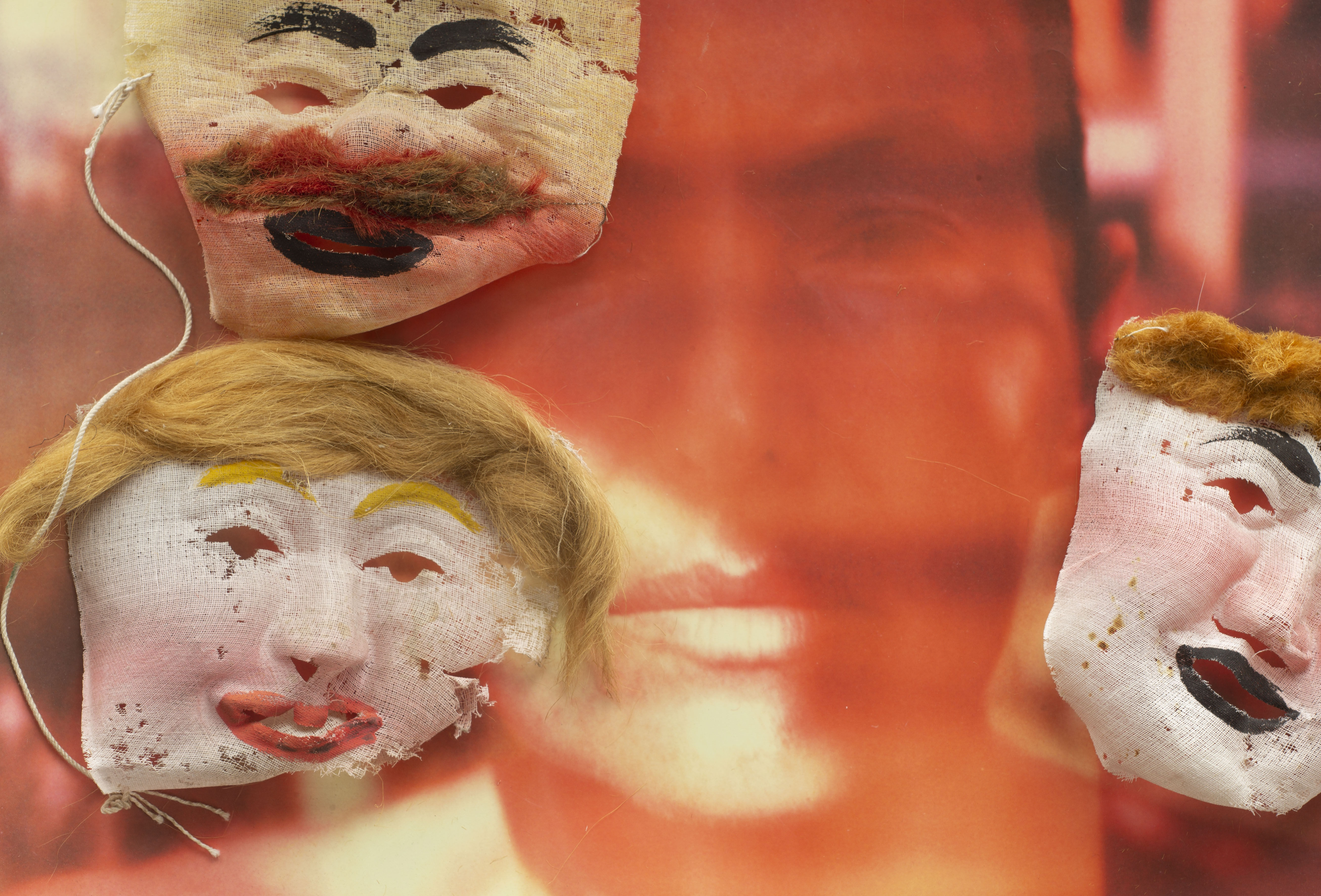
Elfie Semotan’s vast body of work, spanning the past fifty years (3,000 boxes of negatives, 2,000 boxes of color slides, and 30 TB of digital material), is still being carefully archived by her daughter-in-law, curator Úrsula Dávila-Villa. Even the “bad” prints—those that are overexposed and scratched, which Semotan treasures precisely because of these material defects—must be preserved, making the task of cataloguing her oeuvre even more intricate. The photograph that intrigued me most in the exhibition is precisely an overexposed self-portrait, re-photographed with three masks and reprinted years later on a kind of smooth Japanese paper. The masks appear to have human hair and smile mysteriously against Semotan’s sunlit face. When I tried to take a picture with my phone, it captured my reflection; the five of us staring at one another, across time.
On the left wall, there is a dialogue between horizontal and vertical planes, between cement and forest. This still life of rubble is the kind of scene Semotan must have encountered while walking, caught by that Vermeer-like light spilled among the rocks. A contrast with the photograph to its left: a theatre staged among the trees. In the first image, a crumpled salmon-pink sack lies among the grey debris, while in the second, a thick dusty-rose curtain is tied around rough bark, alongside another iridescent silk fabric in pink, green, and gold. I think of Aldous Huxley and his obsession with the grey flannel of his trousers during a mescaline trip: “Civilized human beings wear clothes, and therefore there can be no portraits or mythological or historical narratives without representations of folded fabrics. But even if one can explain the origins, mere tailoring will never suffice to explain the luxuriant development of drapery as a subject of prime importance in all the visual arts. It is obvious that artists have always had a fondness for the fall of cloth or, rather, for cloth itself.”*2
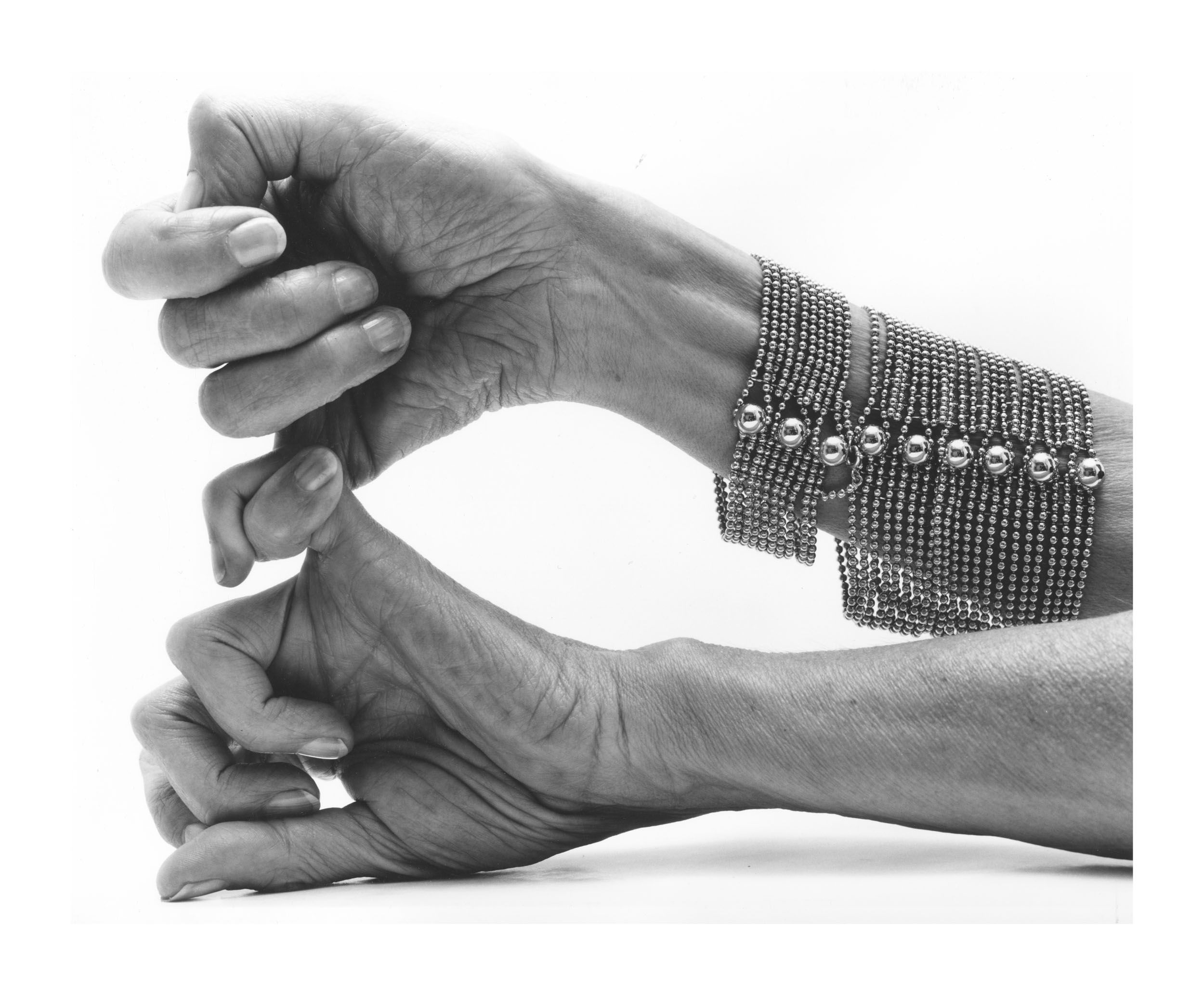
The series Untitled (inspired by John Coplans) possesses the sculptural quality of the work it references, yet what was frankness in Coplans’s naked, aging body becomes here a sharper study of proportions: two little fingers intertwine, emphasizing the elegant tendons of the wrists, both adorned with chains of small metallic beads, while a choker of fine threads wraps strands of silver around the neck. A perfectly cut diamond crowns a knuckle; a diamond photographed like a face.
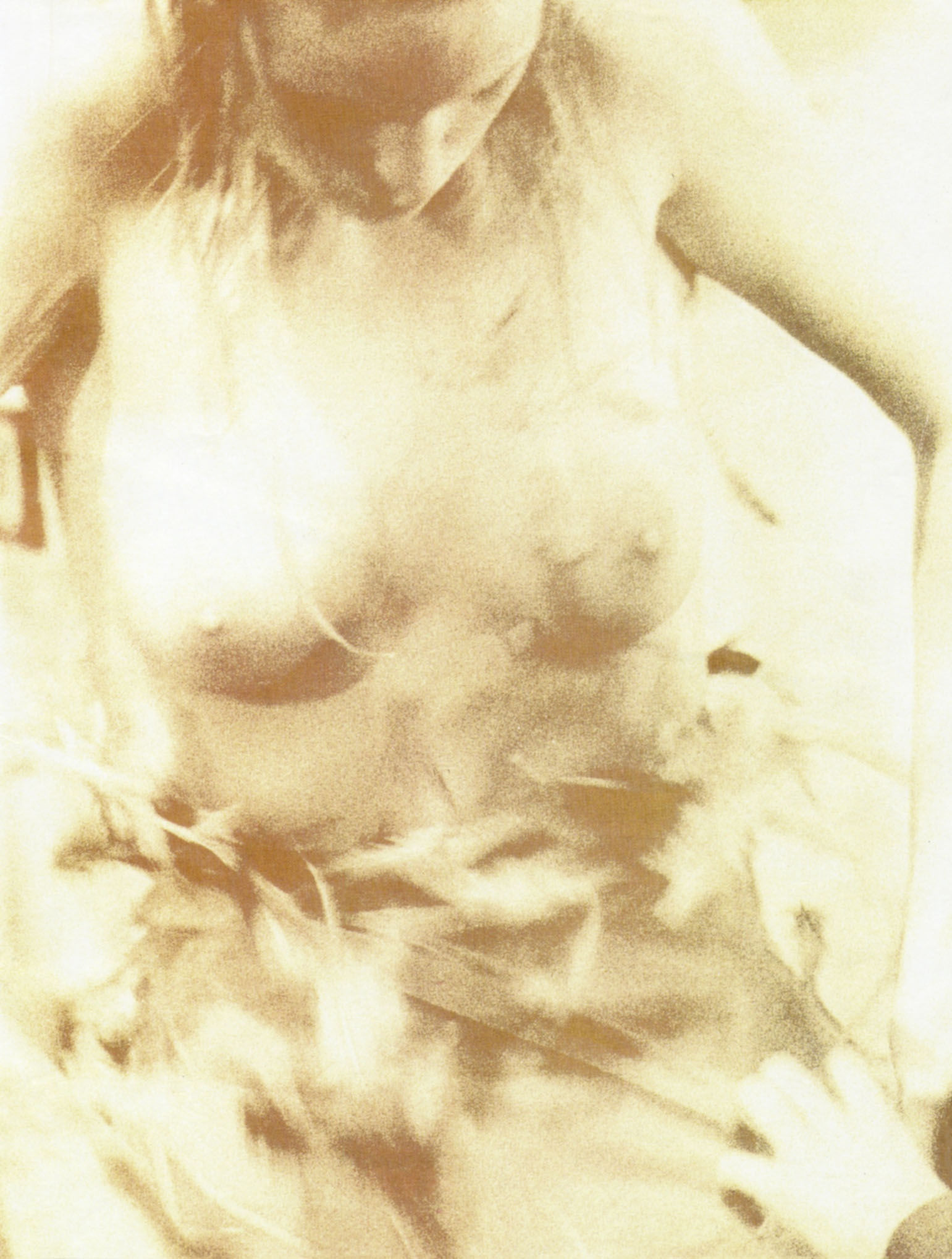
Naked Torso with Feathers has that voyeuristic quality of behind-the-scenes moments during fashion weeks. A model, who appears carved in marble due to the grainy quality of the print, looks downward toward the hand at her hipbone adjusting her dress. The portrait of Helmut Lang reminds me of his use of materials such as rubber, metallic fabrics, and feathers throughout the 1990s and early 2000s. As close friends and collaborators, Semotan and Lang continuously influenced each other’s work. I searched for images from past seasons in which she participated alongside Stella Tennant, Kate Moss, Amber Valletta, Kirsten Owen, and other muses, all dressed in impeccable minimalist designs. When asked about those times, Kirsten Owen shared her memories of the 1998 collection: “If I can quote Juergen Teller,” she replied, “I recall more a smell of raw concrete and hi-fi than a specific memory. A hum.”3 In many of Semotan’s photographs I feel that hum—a sensation that goes beyond the visual, a kind of music.
*1: Muchas de las observaciones reunidas aquí desde las perspectivas de las curadoras independientes Úrsula Dávila-Villa y Anne Stothart se pueden escuchar en la conversación grabada: Radicalidad y Permanencia En Legados Artísticos: Cecilia Vicuña, Elfie Semotan y Lorraine O´Grady, originalmente realizada en Campeche: