
Eric Valencia García: How did this exhibition come about?
Abraham González Pacheco: The works emerge from a technique that is rooted entirely in observation. They are filled with many experiences and personal situations that I have arranged to construct a narrative. Recently, I’ve been visiting my hometown, San Simón el Alto, and I encountered again certain things that have nourished my work since the beginning, even before I entered school—such as experiences with the earth. I am the son of farmers; my father worked in the temporary foreign worker program that sends laborers to Canada. Since I was born, he would leave to work there. That program is a result of the Free Trade Agreement. I lived through all those circumstances tied to the idea of progress that Salinas de Gortari sought to promote. Among them was the notion that concrete represented progress. In my town, the streets were dirt roads, and when these programs arrived, they were replaced with concrete pavement. My father worked for many years in construction at the golf club in Malinalco. When he wasn’t working in Canada, he was working in construction. As a child, he would take me either to the fields or to work with him.
I vividly remember observing something in construction that, with experience, I now understand as a kind of transfer—almost a graphic process. What struck me was that in the formwork, when the cement sets, it absorbs what was in the wood: both the texture and the markings are transferred onto the concrete.
For a long time, I worked in painting from a very personal perspective. Due to certain circumstances that I didn’t enjoy as much, I stopped painting during my studies and focused instead on printmaking, drawing, installation, and other media. I returned to painting about four years ago, and since then I’ve been experimenting. I was invited to participate in another exhibition and began painting some pieces. I had some pigments and earth materials, so I started making mixtures and drew on wooden boards. Then I poured concrete over them, and when I removed it, I was surprised: the paint had transferred onto the concrete, although in some unconscious way I had been expecting it.
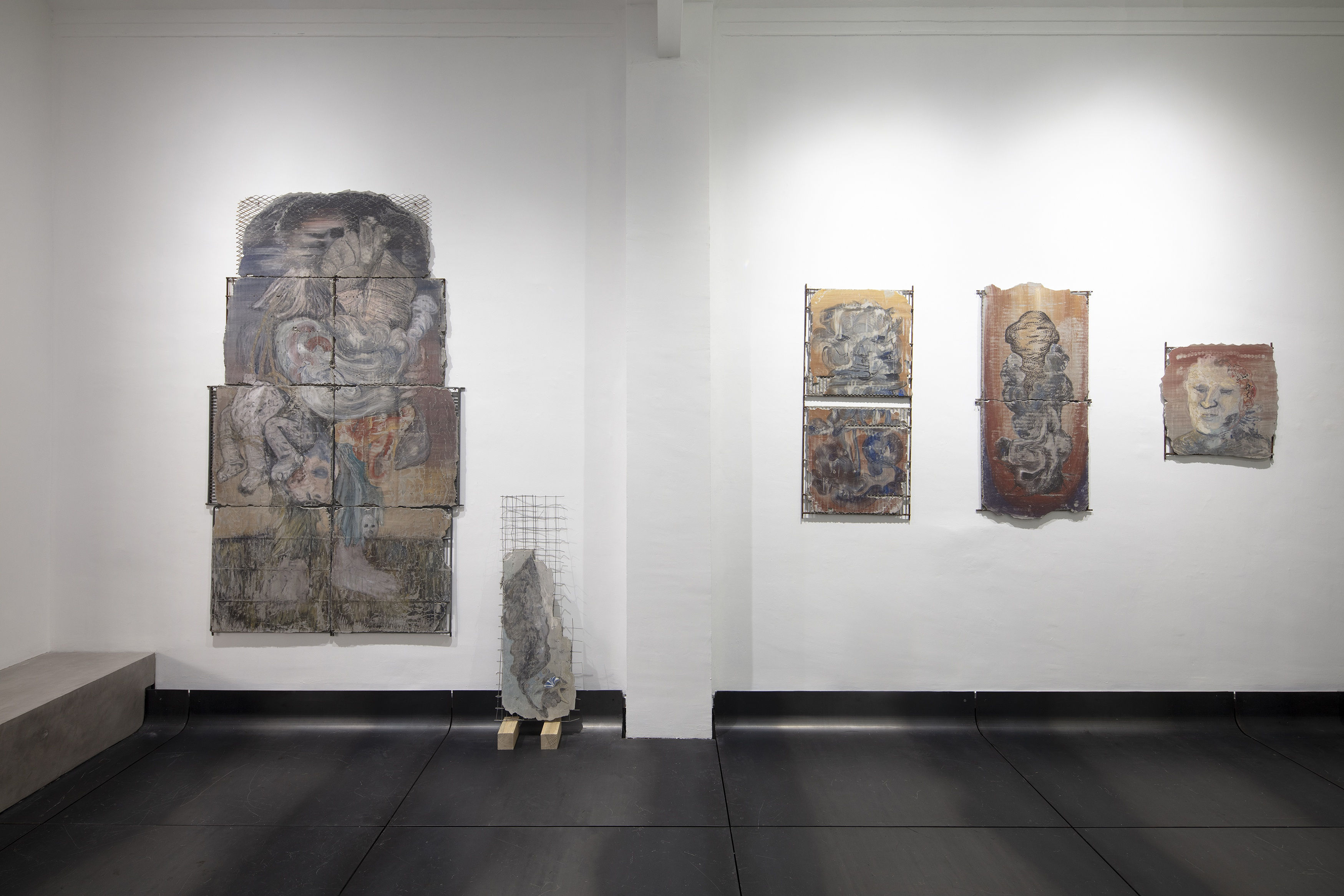
Installation view of Abraham González Pacheco, Paderón. Courtesy of the artist and Campeche. Photo: Ramiro Chaves
I realized that the technique is a monotype. It looks like fresco, but it isn’t. As I progressed with these pieces, I noticed there were factors that slowed me down and that I couldn’t control—things related to the weather, the curing of the cement, the drying time. They prevent the image from transferring exactly as I draw it. At first, I saw it as a confrontation with the work, but later I began to see it as a quality. That’s where the work starts to overflow into another discourse about process, about chance, and about how things function.
People have told me that my work looks like an archaeology of the future—that they are murals coming from a time loop. As you know, in my work I’ve often spoken about this because my town has no recorded history. It’s one of those small towns that seemed to emerge out of nowhere, with no official record; its history has been built from anecdotes passed down from generation to generation and borrowed from different places. And even though my town is very close to Malinalco, it doesn’t have a pyramid as such—although there has always been the myth that one exists. The project I did at Biquini Wax dealt with that: with the potential artists have to create a history or even a lie out of nothing. Like Román Piña Chan and Carlos Hank González when they created the archaeological site of Tenango del Valle.
EVG: Can you tell us about the title of the exhibition?
AGP: The exhibition is called Paderón because my grandfather used to say we were going to the “Paderón” to work, which was a place where peas were planted, near where people say the pyramid is located. There are smooth rocks there—people say they’re walls—and the name stuck as “Paderón.” The word actually exists; it refers to a type of wall found in farmland that divides plots of land, made of stone or adobe, like a ruin. I used to tell my grandfather, “That’s not how you say it, abuelo, it’s pared (wall).” But how can you make people change the way they speak? So instead, I embraced the word and used it as the title of the exhibition, as a direct reference to that place and to that specific moment.
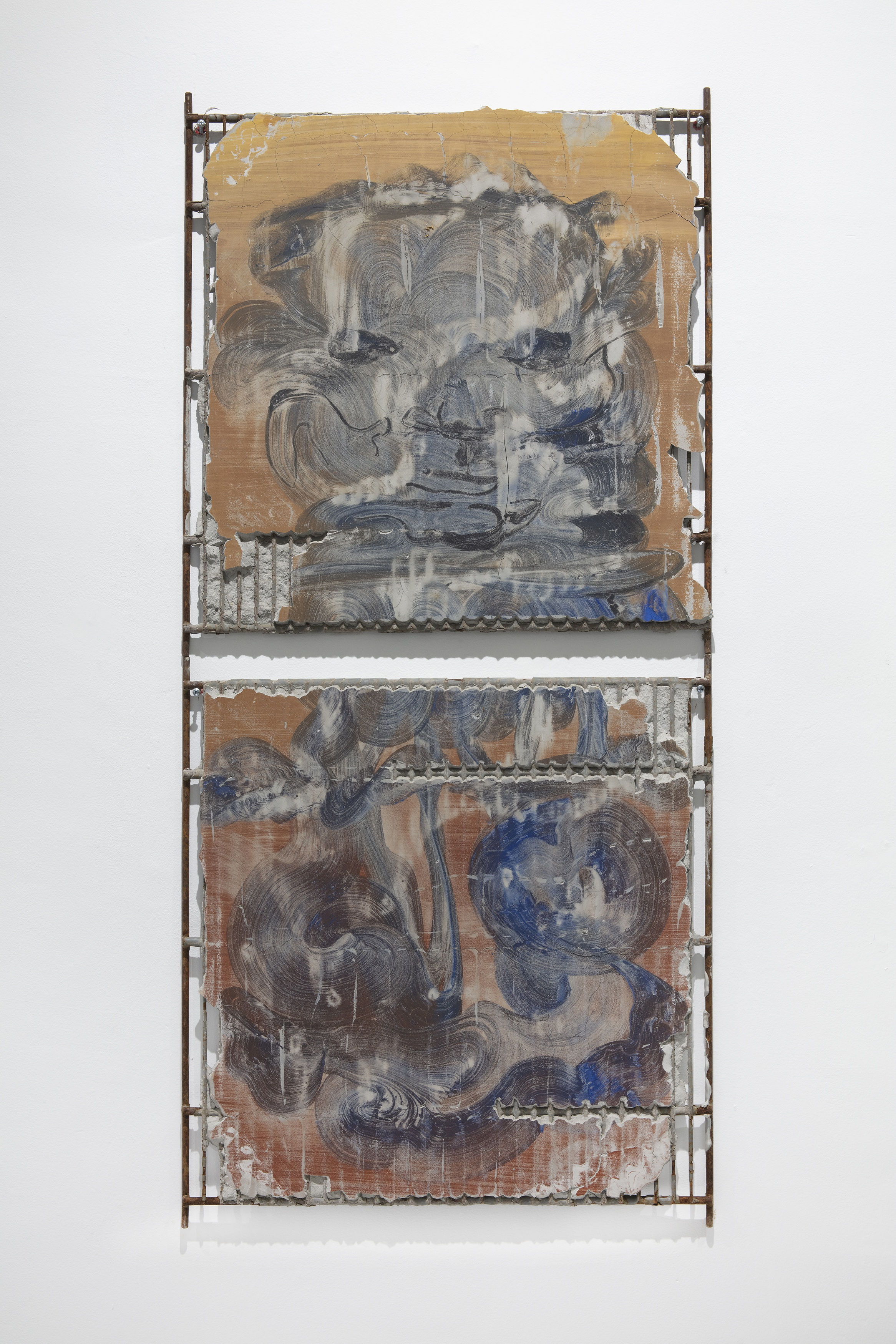
EVG: For this exhibition, the metal structure of the works is much more evident than in your previous pieces. What accounts for that?
AGP: Even though the pieces are heavy, they can be moved—they’re transportable. A mural can’t be moved. They’re like the murals I make that get erased, but these can be taken from one place to another. As for the structures, it’s because I didn’t have the money to have them made by a metalworker—they’re very specific. So what I did was look for materials near my house, in Tepoztlán. I started finding these industrial scraps that have a stronger, more resistant structure.
EVG: Do you think we could think of these works as murals? Perhaps considering more their material qualities than their scale. And in that sense, as paintings that engage with architectural issues…
AGP: Of course—we could even see them as structures, as sculptures. That’s why I consider this to be painting. It has other qualities, like glazes, layers, curtains of color. I could say that the metal structure itself is a layer, that the concrete is a layer of paint. What we see on the surface is also, obviously, painting—another layer. That’s why we also decided to paint the gallery walls, because the wall that supports the painting and the wall behind it are also layers. There’s also something related to the palimpsest: being able to see the landscape through these layers. The palimpsest as a horizon, as a way of understanding painting through these structures.
EVG: The more traditional theory holds that painting is devoted to generating an illusory space on a flat plane…
AGP: Exactly—illusion. And this is completely more material—so material that my back hurts like hell (laughs).
EVG: And matter gets injured too. In the case of concrete, it cracks…
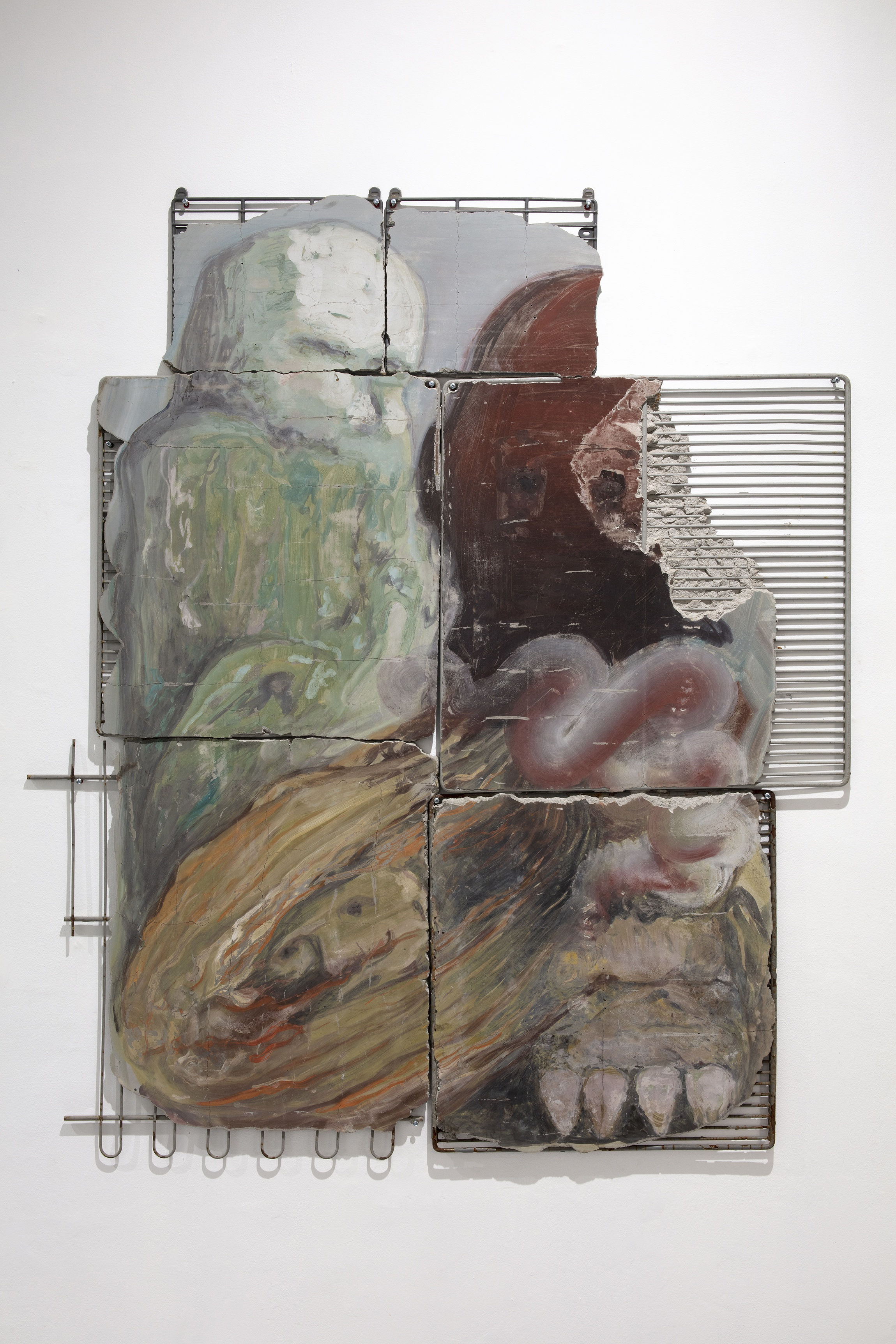
AGP: There are things that might look like a technical mistake (he points to a detail in one work where the concrete appears to have “detached” from the metal structure), but it’s actually a quality because it’s a layer—then comes the metal layer, and then the concrete layer. I keep notes on how it functions because I want to understand the process, but sometimes I won’t understand it. It’s impossible to finish a piece and say, “This is exactly how I wanted it to be.”
EVG: We could also think that progress is a myth partly founded on the idea of mastering material. Or, put another way, mastering nature through technical processes so that matter behaves exactly as one intends. But there are other thinkers who propose that matter also expresses itself. In those terms, we wouldn’t see “technical errors,” but rather different kinds of relationships among the agents involved in the formation of the “material.”
AGP: That’s what really stunned me. It’s not exactly that the material has a specific life of its own, but rather that it responds to circumstances beyond my control. And I think that, as human beings, we should understand that the universe is broader than what we can control. Those “errors” are tangible proof that we cannot control the universe.
EVG: It’s the illusion of control that has led us to…
AGP: …to this chaos! And look, even my skin gets goosebumps, because not being able to control is a fundamental part of this exhibition.
Paderón, of Abraham González Pacheco, can be visited until March 21st at galería Campeche, in Campeche 130, Roma Sur, at Mexico City.
