- ByJuan José Mateos
In the hands of Javier Carro Temboury (Madrid, 1997), pieces of crockery rescued from oblivion in flea markets and street fairs become a ceramic palimpsest in which disparate aesthetics and divergent temporalities merge.
His practice elevates the objet trouvé to the status of a contemporary relic, tracing a rhizomatic tangent of the discarded through the stacking of chipped cups and the fastening together of broken plates. On the occasion of the exhibition Intercontainers at the Centro de Arte de Alcobendas (on view through March 16, 2025), and coinciding with his participation in the group show Técnica mixta at the Madrid gallery Lapislázuli (February 20–April 5), we spoke with Carro Temboury to learn firsthand about the keys to his work.
At the Centro de Arte de Alcobendas, your projects Café Transversal and Intercontainers are being shown together for the first time, creating a dialogue between the two bodies of work. What is the chronology of these projects, Javier?
I began working on Intercontainers in 2022. The first Café Transversal, for its part, had its conceptual origin in 2022 as well, although the first action took place in June 2023. This initial version was quite different from the later ones. It was a group exhibition in my studio in Paris in which, together with Eladio Aguilera, we recreated the atmosphere of a Viennese café. We didn’t produce physical pieces as such; rather, we created an immersive space, an installation that functioned as an invitation to 17 other artist friends. The idea for this first version of Café Transversal was inspired by Viennese cafés, with their wooden décor and hooks on the walls. It played with the notion that these spaces can resemble minimalist exhibitions when empty, and how they are transformed by the presence of people and their belongings. I invited the artists to bring a piece— it could be a cap, trousers, a bag, a shirt— and hang it during their time in the café. The exhibition was fluid and constantly changing depending on who came and went.
And that first Café Transversal was followed by several iterations that share the same formula: a happening in which ceramics play a crucial role and become the raw material for subsequent sculptural production.
Yes, the second Café Transversal took place during a residency at the French Economic, Social and Environmental Council, an official body akin to a small Senate, though without legislative power. The idea of the café was to invite the employees, security staff, passersby, installers, my friends— in other words, to place a very long table— which in fact blocked access to the official dining hall— almost like a sabotage of the cafeteria service behind it. I used a horizontal structure in which all the cups arranged on it held the same value, the same importance.
We are talking about a space of power in which you carry out an act of blockage, inviting service employees and security staff to make their presence visible there through the act of having a coffee and conversing among themselves.
Exactly. To do so, I used cups and saucers sourced from local flea markets which, once used and after the action had concluded, I cast as sculptures. The pieces were exhibited in that same building, one of the masterpieces of Auguste Perret. Perret was the first French architect to use reinforced concrete in a noble way, and this building is a palace constructed for the 1937 Paris International Exposition—an extraordinary feat at the time precisely because it imagined such a vast space built entirely of reinforced concrete, using pebbles from nearby quarries and water from the Seine River itself, which runs alongside it. I admire this architect’s capacity for projection, for envisioning a reinforced concrete structure, and in response I wanted to develop an intervention that would take up the building’s materials while also diverting the flow through that lobby, which people normally cross in a straight line.
So Perret’s architecture and his capacity for projection became an inspiration for materializing your proposal.
Yes, and also the very construction of the building, which is made of cast concrete. To create something like that, you have to imagine the space in negative and build a mold, a formwork. In other words, to make a column you must first calculate the inverse volume—the container into which you will pour the concrete. The twist was to invert the function of the vessels used for drinking coffee, transforming the container into content.
And to this exercise in inverting empty space you add the encapsulation of the objects from which participants have drunk—material that you preserve exactly as they leave it, with traces of coffee, remnants of tea, lipstick marks. I would say that in that gesture there is a desire to preserve something of the warmth of that social interaction, to allude to the intimate aspect of sharing a coffee and conversation with someone.
Absolutely. Especially in Café Transversal III, which took place in a nonprofit art space called Pech in Vienna. It’s a city I feel connected to, since I lived there for several months in 2022. I have a whole community of friends there, and the idea was also to return to the concept of the Viennese café—a lively space in which the audience is actively asked to choose an object, use it, and decide where to place it. What I seek is to create a situation: through that protocol, those instructions for use, a space opens up for randomness to infiltrate. I let chance enter, I allow life itself—the unpredictable—to slip in.
And after Vienna, Café Transversal IV returns to France.
Yes, the fourth iteration arose from an invitation by the Musée de Saint-Étienne, a fascinating public museum. What’s interesting about this institution is that it has been acquiring avant-garde art since practically the 1950s, and it holds an impressive collection of major artists from the ’50s and ’60s. They were pioneers in France, organizing the first exhibitions of artists such as Frank Stella or Robert Morris. What’s striking is that Saint-Étienne is a working-class city, an hour from Lyon, which would be the quintessential bourgeois city. Saint-Étienne has a mining past, as well as arms manufacturing and industrial textile production. It’s surprising that a city like that—one not generally held in high esteem by the French—houses such an important collection. The proposal excited me because the museum had not been renovated since its construction. After two years of works, they had decided to install terrazzo flooring throughout the building. The museum’s chief curator, Alexandre Quoi, who had followed my previous projects, invited me to create pieces that would mark the close of this period prior to reopening. Returning to the café strategy, we organized an intimate gathering with the museum staff. The pieces I created appeared during the reopening weekend, like capsules enclosing that preceding moment—those months before reopening and the reunion of employees in September. I produced the works in collaboration with the company that installed the flooring. It was quite an entertaining experience because, as always, each project in a new city brings unexpected adventures—from sourcing all the cups to finding the flooring company and locating a marble worker receptive to the idea.
In fact, one of the key features of your work is that you don’t have a permanent studio or a go-to artisan you always rely on; instead, each project takes you to a new city, where you seek out local collaborators to materialize what you have in mind.
Yes, exactly. There is always a margin of uncertainty, because I’ve never worked with those people before. There’s a process of negotiation, of mutual understanding. But that is precisely what makes each project unique and exciting. There are two very interesting aspects to this. On the one hand, there is the know-how, the specific knowledge of each place. Every city, every region, has its own techniques and craft traditions. I learn so much from local artisans with each project. On the other hand, there is the materiality of the work. In Saint-Étienne, for example, I went to local flea markets to source the ceramics. These are pieces that have been part of the everyday life of that region. There is no importation—everything is local. This gives the work a very deep connection to the place where it is created; it is a way of working that avoids homogenization. Each piece carries the essence of the place where it was made, from the materials to the techniques used, but also the contemporary processes of commercial import and export. Even though everything was purchased in France, there are pieces from Toledo, German pieces, Moroccan pieces—objects from everywhere.
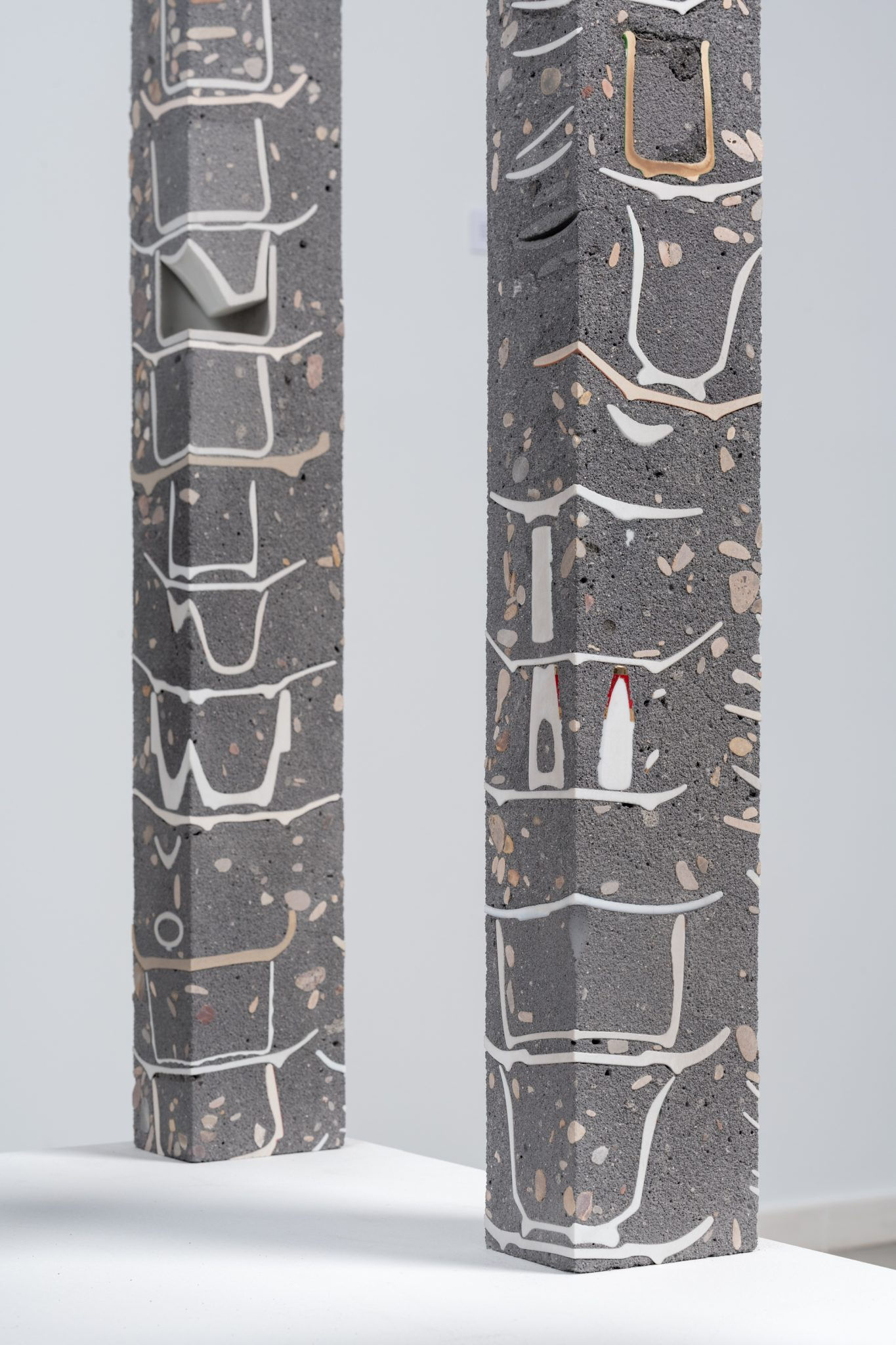
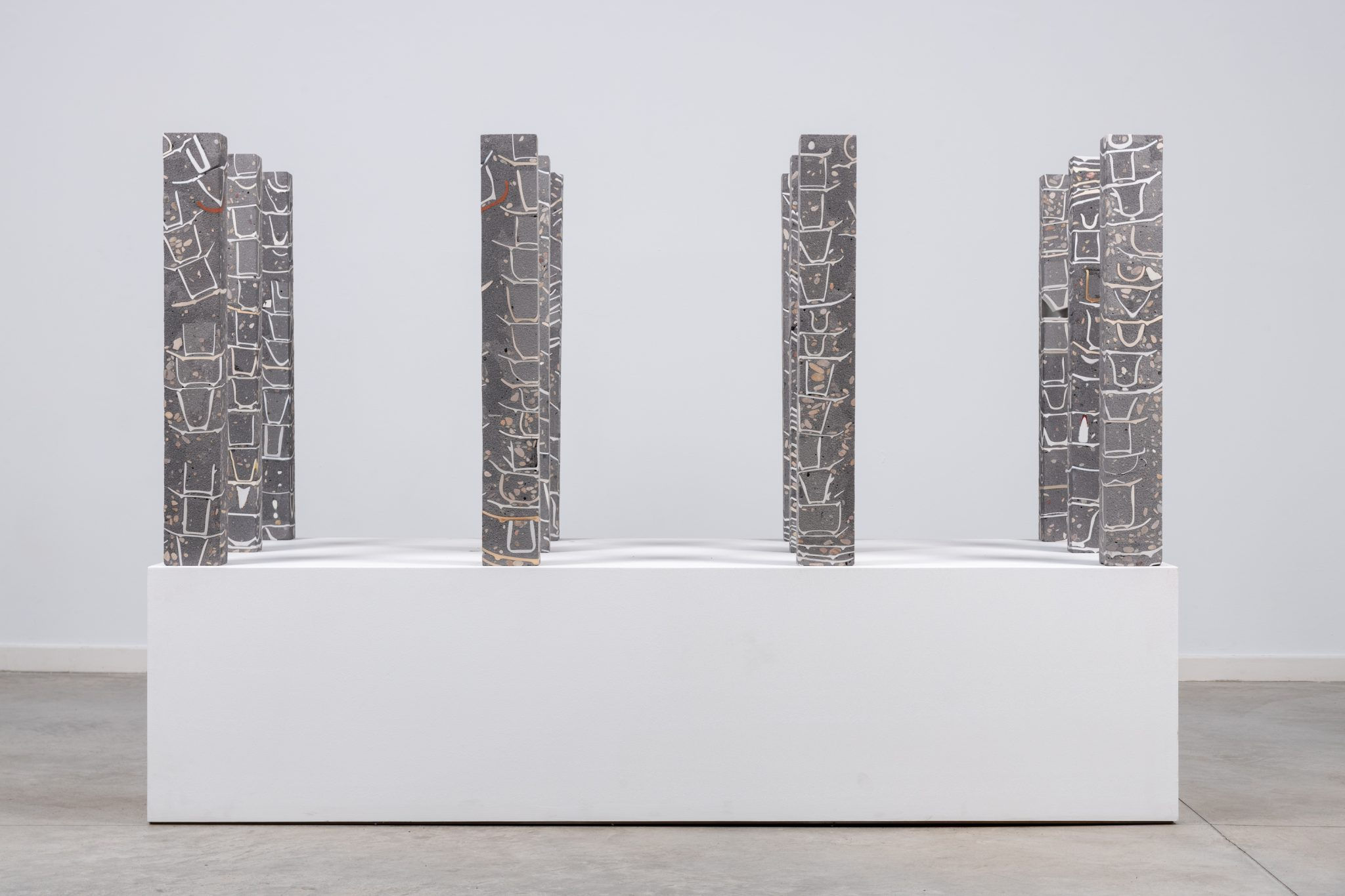
The happening of Café Transversal V took place here in Madrid, at Arniches 26, and the resulting works are now on view at the Centro de Arte de Alcobendas. In addition to having a vertical projection that distinguishes them from your earlier pieces, the cement used for the casting is also different.
The project at Arniches was very special. I love its location because it’s right in the heart of El Rastro, so some of the pieces I incorporated came from there. It’s as if the work absorbed the essence of the neighborhood. As for the cement, it does indeed have a more grayish tone than the one I used in Saint-Étienne. I used a different type of cement and also included river gravel, which fascinates me because it connects with that romantic idea of building with materials from the surrounding environment, as Perret did. I began incorporating these elements in the second project, seeking a kind of mimicry with the environment. It also nods to terrazzo technique and reinforces that mineral aspect that interests me. As for the number of pieces—twelve—they correspond to the original arrangement of the table. It’s important to maintain that connection to the initial event.
Twelve towers of stacked cups, cast in cement and presented like geotechnical core samples, with something archaeological about them—like a spine, like the discovery of fossil remains.
The idea of the human spine is, in fact, an obsession that has been present since the beginning of the project. I’m fascinated by that structural aspect of our bodies, that sort of support that keeps us upright. In a way, I see the cups as structures for conversation, fulfilling a similar function. There’s an interesting play on words there: what runs inside the spine is the nervous system, and in these pieces, what runs inside is coffee. I find that analogy suggestive. I’m also drawn to the inevitable fossil-like quality of the works—white forms standing out amid the earth. For me, there has always been a connection between bone and ceramics. The idea of the cluster—of influences, of how we shape our sense of self from a confluence of diverse elements—is something that deeply interests me. I liked the idea of creating a kind of Frankenstein, erecting a figure from a multitude of different influences or people. I’m interested in that moment of hominization and technological development, in how the biological changes of the body standing upright go hand in hand with the ability to create objects.
Fire, used to fire ceramics, is a perfect example of that.
Absolutely. And these objects are, in fact, extensions of our bodies. Our finger cannot pierce like a needle or hold water like a cup. I found it interesting to evoke the body through all those objects that function as its temporary extensions—for eating, drinking, containing… It’s about returning to the origin of objects, because ultimately, that’s what they are: extensions of our bodies and our needs.
But objects are perishable, and matter is fragile—especially ceramics.
Yes, you’re right. It’s a reality I work with constantly and that has, in fact, become an integral part of my creative process. It’s curious, because on the one hand, that attachment to the object—speaking about the life of objects—is very important to me. But working with ceramists, I’ve realized that they have a different relationship to their creations. Unlike other artists, for whom the object itself holds almost sacred importance, ceramists seem “vaccinated” against excessive attachment. They have fully incorporated the idea that not all pieces will survive the process. It’s almost like a Darwinian calculation: out of twenty pieces we make, we know some will crack while drying, others will explode in the kiln, some will glaze poorly, and others will break during installation. It’s a kind of artistic natural selection—the final piece has passed through a process of selection and proven its resilience.
I wonder how much of that Darwinian process is present in Intercontainers. I have the impression that you have —very consciously— established a set of parameters that serve as an anchor for the future, but that can also limit and constrain you. Fidelity to the longitudinal axis implies a commitment on your part to the rules of the game you have imposed on yourself.
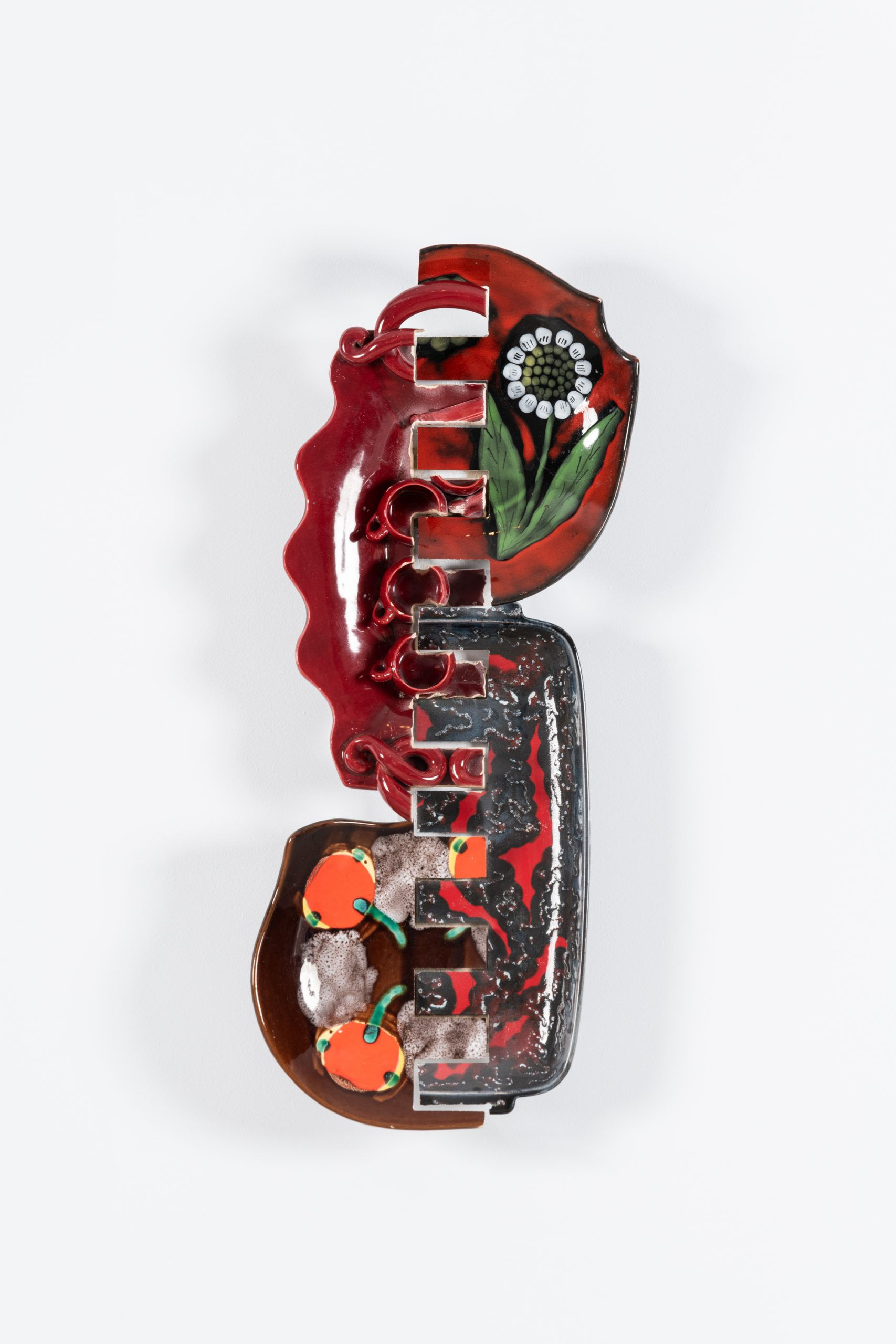
Well, Intercontainers is a project with the ambition of being long-term. The very name defines the rules of the game, the working protocol. All the pieces in the project are Intercontainers, with a subtitle in parentheses that hints at a specific intention—sometimes almost like an internal joke. It’s important that when you read the title, you immediately think of the ensemble, of the whole. The initial piece is like a long statement, and the subsequent wall pieces are like shorter sentences, associations of words or ideas. It’s interesting how, in the initial piece, the concept of the container has already been completely blown apart. You can see traces, a mix of origins, aesthetics, ways of life. There are countless connotations: a scorched saucepan because it was forgotten on the stove, another that recalls a grandmother, another whose decoration seems Moroccan… But these connotations, although invited into the piece, are actually contingent. The core of the work is the purely conceptual proposal of the protocol. The idea of Intercontainers is what lies at the origin; all these connotations infiltrate—or I actively invite them in—but they are secondary to the central concept.
And the cut plays a crucial role within that protocol.
Yes, exactly. The cut is a fundamental constant in my work, and it’s important to emphasize that it is not arbitrary. It is based on an ancient carpentry technique: tongue-and-groove joinery. It’s a construction system that fascinates me because it allows you to move from a two-dimensional plane to a three-dimensional one. Imagine two wooden boards: by cutting them with this tongue-and-groove system, you can transform them from a 2D plane into a 3D structure. It offers a very interesting constructive and gripping capacity. I enjoy playing with how a single intervention can radically alter the perception of an object. It’s similar to what I do with Café Transversal. In this case, we are applying a 2D drawing—like the kind an architect or object designer would make to define a cup in elevation or profile—but we do so in reverse. With Intercontainers, I apply this 2D cut blindly and indiscriminately onto volumetric objects, which produces surprising effects. For example, in a jug, the cut may not appear straight because of the object’s curvature, but if you look at it from above, you’ll see that it is perfectly straight. It’s a kind of game between dimensions, a transition between the flat and the volumetric. It’s a way of reinterpreting everyday objects and giving them a new life, a new dimension, if you will.
But that reinterpretation also has something playful that escapes an ordered method.
Absolutely. That possibility of play is fundamental to my work. It is an active and essential part of the concept. The idea that any of the pieces can fit together is crucial. It’s like a metaphor for how everything can connect, articulate itself. There’s something very interesting about applying the same rule to all the pieces, without accounting for each one’s exceptions. I think this reflects something about our society. Without presenting myself as an absolute defender of order—which I’m not—I believe there is something valuable in maintaining that rule, that specific size of the cut’s teeth. Even if it was initially chosen arbitrarily, maintaining it is what allows all these individual objects to articulate with one another. It’s like the rules that enable coexistence in society. For example, the fact that we can all print on A4 paper, or that in Spain people drive on the right. They are forms of order that facilitate coexistence.
It’s important to note that, although these pieces are not figurative nor explicitly representational, they do play with notions related to the soma, to the organic body.
Yes, you’re right. In the newer pieces, especially the more monochrome ones, aspects emerge that perhaps were not as evident in the main piece. The question of the body—of the organic and the inorganic—becomes more prominent. Scale plays an important role. There’s an allusion to height, to genetic variations between individuals.
There is also the idea that all these objects are, in a way, extensions of the human body: for drinking soup, for containing liquids… They are objects that have had intimate contact with the body. At the same time, there is a reflection on how we ourselves are a kind of “container.” We are, essentially, a sack of skin that contains blood vessels, a digestive tract… The idea of the vessel defines us in some way.
To conclude, I don’t know if you can share anything about the projects you’re currently developing.
Next month—March 2025—I will be in Mexico City developing the sixth Café Transversal at Galería Campeche. I can also share that Café Transversal will have a permanent version in collaboration with an architectural studio (Atelier Martel) on the outskirts of Paris. We have won a competition to build social housing, and my proposal is to integrate an autonomous café during the building’s construction. The idea is that this café will be available to the construction workers. It will function as a kind of counter for their breaks and moments of rest. All those instances in which they regain energy and strength will be recorded and will become the symbolic foundation of the building. Once construction is complete, there will be a six-story building, but at its base there will be a small plinth where all those sedimented cups can be seen. It’s as if they were a modern caryatid, metaphorically supporting the structure.
It’s important to me that this project highlights the value of the people who make construction possible. It’s a nod to those who dedicate their daily labor, effort, and time to creating these structures. Often, the physical and mechanical work behind a building goes unnoticed. Someone has quite literally strained their back to make it happen. It’s a project that truly excites me and one that I can announce with considerable certainty. I think it encapsulates many of the ideas we’ve been discussing: the value of labor, materiality, and the connection between the everyday and the monumental.
Juan José Mateos
Images are courtesy of IDC Studio taken in the exhibition Intercontainers of Centro de Arte de Alcobendas.
March 4, 2025
