
- Cristina Torres
The erotic is a space between the emerging awareness of one’s own being and the chaos of the strongest feelings.
Audre Lorde
For the Western gaze, to speak of light often implies speaking of the visible, of the eye-as-camera and the admission of an evident objectivity. A perception that, due to its hegemonic condition—and therefore rationalist and patriarchal—accesses only a flat, superficial luminosity; light as something to enter and dissect. To intuit light from its darker, subdermal facets requires an entirely different set of abilities, a certain vibrational sensitivity, a willingness to feel one’s way through.
With this embodied, vulnerable, receptive, multiple, and attentive gaze, La luz proviene de ahí (The Light Comes from There) speaks—the inaugural exhibition of Campeche on the eponymous street in Colonia Roma. Participating artists include Alicia Ayanegui, Julieta Gil, Darinka Lamas, Berenice Olmedo, Paloma Rosenzweig, and Astrid Terrazas. The works installed in the space emerge from contact, skin, and chaos; from knowing oneself within a world that separates what is joined, historicizes what it hierarchizes, and fears the power of shadows.
Each work is a germinal declaration of polyglot voices that preserve the memory of a preverbal place, of a phenomenon composed of layered modes of being and existing—that is, of writing within this sexist regime of biopolitics, within ableism, within the distribution of the sensible, within the norm of Enlightenment reason’s lights. The masculinist gaze turns reality into a subject that expels the body outward; erotic voices act because life passes through them.
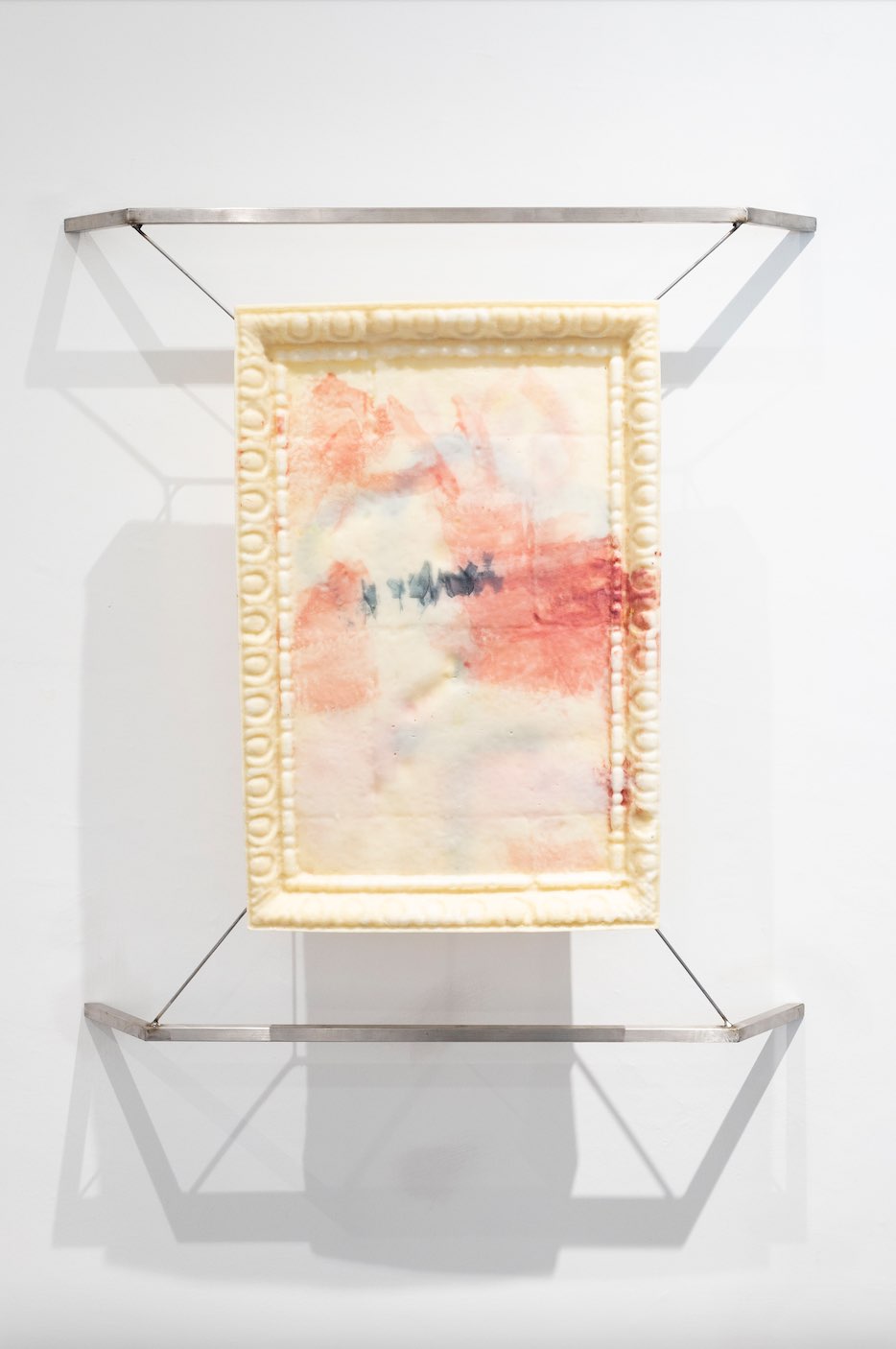
Pedestal para una persona digna de ser recordada (Pedestal for a Person Worth Remembering) by Julieta Gil continues her investigation into the inscriptions of feminist protests on urban monuments in Mexico, rescuing—through complex 3D mapping techniques—the collective traces that bear witness to a political struggle deliberately erased to minimize and render invisible its historical imprint. In this case, she materializes the record in beeswax and pigments. In her words: “How do we represent plurality, temporality, and the multiplicity of histories over time through objects that would otherwise represent only the timeless, monolithic, monumental, permanent, hegemonic, and patriarchal?”*1
Darinka Lamas presents two works in which she explores the relationship between architecture, the material history of its components, and the choreography produced by the bodies that move through it. In the video Limítrofe, we see the artist balancing her body on a brick atop a mattress—prisms upon prisms within prisms built to contain and shelter bodies. In the sculpture Recuerdo que ni la materia más dura conserva su forma (I Remember That Not Even the Hardest Matter Retains Its Form), similar bricks appear inscribed with dust from found materials, forming phrases such as: “Fossilized magma where I have lived my entire life,” “Chance amalgam of two times and two spaces,” “A doorstop that allowed light to slip inside.”
Spread across the gallery floor are the sculptures titled MEKHANÉ, Akro-Bainein, and TEA, in which Berenice Olmedo uses orthopedic materials—most of them sourced from a tianguis in Iztapalapa—such as stockings, limb orthosis bars, corset collars, and girdle rods. The works suggest small bipedal entities that walk and stand upright. The artist focuses on the medical scaffolding used to support bodies that, for multiple reasons, cannot do so on their own, alluding in a manner both playful and direct to an inherent vulnerability and fragility—one that is compounded by class oppression and marginalization.
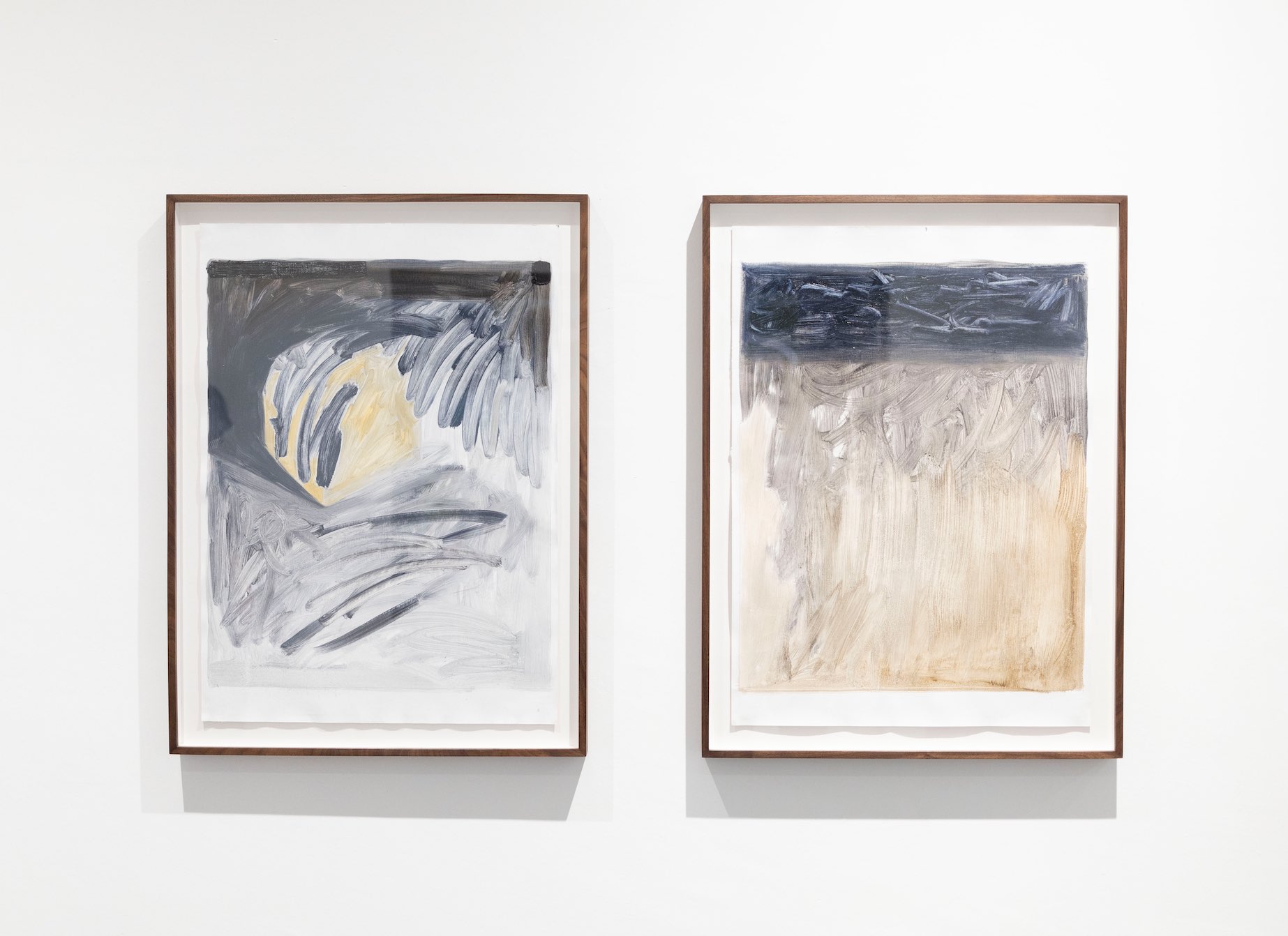
Alicia Ayanegui presents Dentro and La luz proviene de allí, the latter lending its title to the exhibition. As part of her painterly inquiry rooted in a nocturnal imagination, these works investigate the membranes through which light peers into the darkness of intimate spaces—spaces reconstructed through this encounter of energies, absorbed by an atmosphere of stillness and contemplation brimming with potential: “The erotic is like a seed I carry within. When it spills out of the capsule that keeps it compressed, it flows and colors my life with an energy that intensifies, sensitizes, and strengthens my entire experience.”*²
Astrid Terrazas creates collages composed of cultural symbols and body parts that are meaningful to her personal history—she migrated from Mexico to the United States as a child. Cantando himnos en el jardín atrás de Walgreens (Singing Hymns in the Garden Behind Walgreens) reflects a search articulated through abstract geometry that in some ways recalls the compositions of Hilma af Klint, Surrealism, and figures from ancestral traditions. The work conveys a code that feels deeply intimate, like a chromatic and allegorical pictobiography about personal transformation and a sense of belonging.
_16_27_12.jpg?alt=media&token=ceb678ed-31e0-425d-83b8-8c0cd610d7c9)
Dos vértebras is part of Cuerpos suaves, Paloma Rosenzweig’s latest series, in which she renders organs and bones in felt, at a different scale. In contrast to a Western history of anatomical representation that opens and penetrates bodies to expose their details, this sculpture—alongside the drawing Fibras 2—offers a tactile and gentle gaze upon the structures that sustain our biology and allow us to move through the world. It is a delicate, material, lived anatomical writing.
Audre Lorde wrote about the importance of learning to understand the latent and ancient power of our bodies: “Our erotic knowledge empowers us, becomes a lens through which we scrutinize all aspects of our existence, forcing us to evaluate them honestly and to assign them the relative value they have within the whole of life.”
Taken together, the works in the exhibition speak from this deep and multiple way of knowing—from the inescapable political dimension that runs through us, to the need to write with the awareness that we do so with the flesh. Life also springs from the embrace of the night.
All quotes by Audre Lorde are from “Uses of the Erotic: The Erotic as Power.”
1: Julieta Gil quoted in the curatorial text of the exhibition.
2: Audre Lorde
Pagina web: https://www.ondamx.art/escrito/desde-el-abrazo-de-la-noche-la-luz-proviene-de-ah-en-campeche--hQ9dQOGNG781lFgaSPCo
© Onda MX 2021
